What Is a Disposable Vape? (2026 Complete Guide)
Disposable vapes have become one of the most widely used vaping products globally. Users often search for: what is a disposable vape, how it works, and whether it is safe or legal in 2026.
This article explains disposable vapes in a structured, evidence-based format, including how they work, comparisons with traditional devices, safety considerations, and regulatory frameworks in Australia and the UK.
What Is a Disposable Vape?
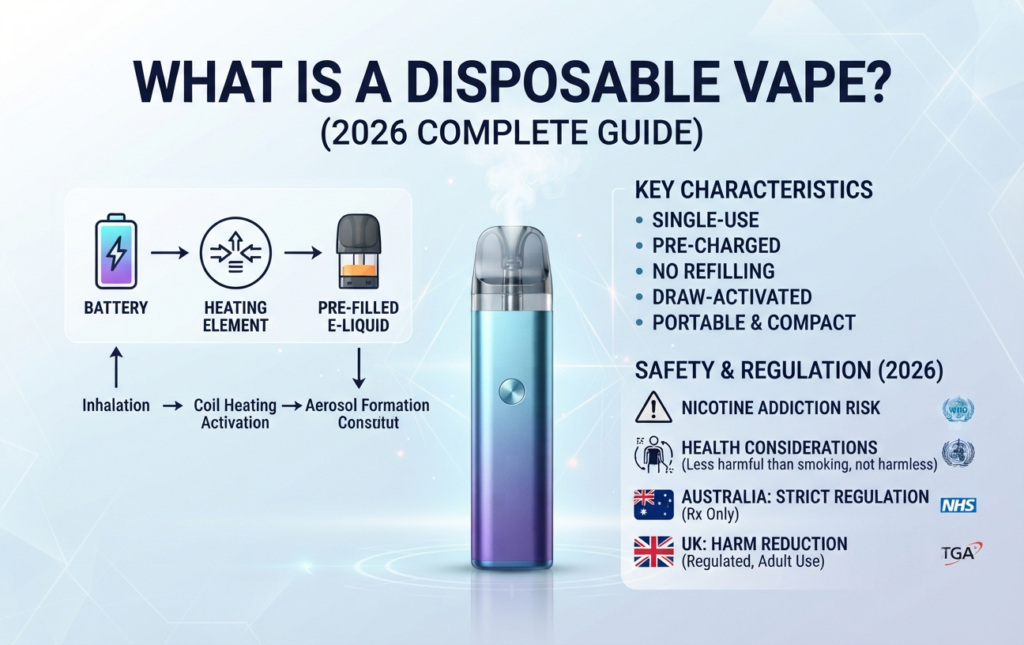
A disposable vape is a single-use electronic nicotine delivery system (ENDS) that comes pre-filled with e-liquid and pre-charged.
Once the e-liquid or battery is depleted, the device is discarded.
Key characteristics:
Pre-filled with e-liquid
Non-rechargeable or limited recharge models
No refilling or coil replacement
Draw-activated system
Portable, compact design
Disposable vapes belong to the category of electronic nicotine delivery systems (ENDS) as defined by public health and regulatory agencies.
How Does a Disposable Vape Work?
Disposable vapes operate through a simple aerosol generation system:
1. Battery Power Source
A lithium-ion battery provides electrical energy to the heating system.
2. Activation Mechanism
An airflow sensor detects inhalation and activates the device automatically.
3. Heating Element (Coil)
The coil heats a wick saturated with e-liquid, typically containing:
Propylene glycol (PG)
Vegetable glycerin (VG)
Flavoring agents
Optional nicotine salts
4. Aerosol Formation
The heated liquid produces an aerosol (commonly called vapor), which is inhaled.
Operational chain:
Inhalation → Sensor activation → Coil heating → Aerosol generation
Disposable Vape vs Traditional Vape Devices
| Feature | Disposable Vape | Traditional Vape (Pod/Mod) |
| Usage | Single-use | Reusable |
| Maintenance | None | Cleaning/refilling required |
| Battery | Pre-charged | Rechargeable |
| Customization | Limited | High (power, airflow, coil types) |
| Device lifespan | Short-term | Long-term |
Interpretation:
Disposable systems prioritize ease of use, while refillable systems prioritize control and customization.
Is a Disposable Vape Safe?
Scientific consensus overview
Disposable vapes are not risk-free products.
According to major public health authorities (including WHO and national health agencies), vaping generally exposes users to fewer toxic substances than combustible cigarettes, because there is no tobacco combustion.
However, aerosol emissions still contain:
Nicotine (in most products)
Ultrafine particles
Volatile organic compounds (in low levels)
Flavoring byproducts
Key health considerations:
Nicotine is highly addictive (US Surgeon General)
Long-term effects of vaping are still being studied
Short-term irritation of respiratory system may occur
Important clarification:
Disposable vapes are not designed or approved as health products or cessation therapies in most jurisdictions.
Disposable Vape Laws in Australia (2026 Overview)
Australia has one of the strictest regulatory frameworks for vaping products.
Regulatory framework:
Nicotine vaping products classified as prescription-only medicines
Importation restricted under national customs regulations
Retail sale of nicotine vapes is heavily controlled
Strict age restriction (18+)
Policy basis:
Regulation is based on national therapeutic goods and poison scheduling frameworks.
Disposable Vape Laws in the UK (2026 Overview)
The UK applies a regulated harm-reduction approach.
Key regulations:
Legal for adult use (18+)
Nicotine concentration limit: 20 mg/ml
Tank capacity restrictions under tobacco product regulations
Mandatory product notification under MHRA framework
Public health stance:
UK health authorities (including NHS guidance) recognize vaping as a less harmful alternative for adult smokers, while still warning about addiction risks.
Why Are Disposable Vapes So Popular?
Several behavioral and market factors explain their growth:
Low learning curve (no setup required)
Portability and convenience
Wide flavor availability
Lower initial cost compared to refillable systems
Strong retail distribution in legal markets
Scientific & Regulatory References
1. Nicotine and addiction science
US Surgeon General Report (2014, updated summaries ongoing)
Nicotine is a highly addictive chemical affecting brain development and reward pathways
2. Aerosol chemistry in e-cigarettes
National Academies of Sciences, Engineering, and Medicine (NASEM, 2018)
E-cigarette aerosol contains fewer toxicants than combustible cigarette smoke, but is not harmless
3. WHO position on vaping
World Health Organization (WHO)
Vaping products are harmful and should be regulated; long-term effects remain uncertain
4. UK public health framework
NHS (UK National Health Service)
Vaping is less harmful than smoking but not risk-free; recommended only for adult smokers
5. Australian regulatory classification
Therapeutic Goods Administration (TGA)
Nicotine vaping products are regulated as prescription-only medicines in most cases
6. Chemical composition of e-liquid
Studies on PG/VG aerosolization chemistry (peer-reviewed literature in journals such as Tobacco Control)
Heating PG/VG produces aerosol particles and trace carbonyl compounds under high temperature conditions
Conclusion
A disposable vape is a single-use electronic nicotine delivery system designed for simplicity and convenience. While it is widely used as an alternative to smoking, it still contains nicotine and other aerosolized substances that carry health risks.
Regulations vary significantly between countries such as Australia and the UK, reflecting different public health strategies and legal frameworks.
Understanding both the functional mechanism and scientific background is essential for informed decision-making.