
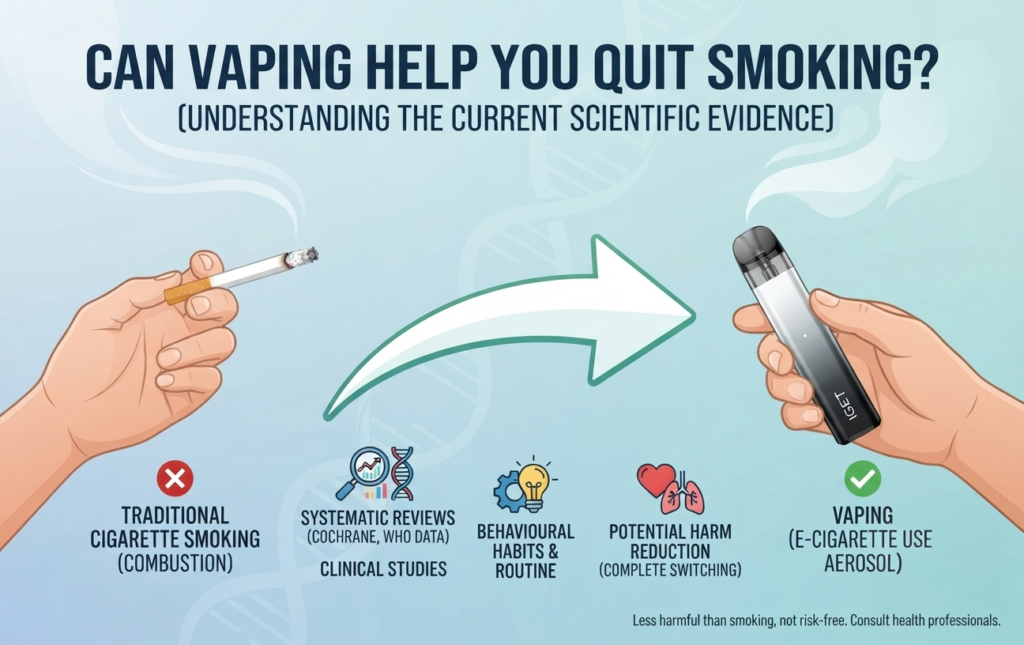
Can Vaping Help You Quit Smoking?
Understanding the Current Scientific Evidence Behind Vaping and Smoking Cessation
Introduction: The Relationship Between Vaping and Smoking Cessation
The question “Can vaping help you quit smoking?” has become one of the most widely discussed topics in modern nicotine research.
For decades, millions of adult smokers around the world have attempted to quit traditional cigarettes using different approaches, including behavioural support, nicotine replacement therapy (NRT), prescription medications, and more recently, electronic cigarettes.
The relationship between vaping and smoking cessation remains a complex scientific topic. Research has explored whether electronic cigarettes can help some adult smokers reduce or stop cigarette use, while also examining potential risks, long-term health questions, and the importance of preventing use among people who have never smoked.
This article reviews the current scientific evidence surrounding:
How vaping may influence smoking cessation
What clinical studies show
The differences between vaping and traditional smoking
The limitations and ongoing questions in research
1. Why Do Some Smokers Consider Vaping to Quit Smoking?
Smoking addiction involves several different factors.
Nicotine dependence is one important element, but smoking behaviour also involves:
Daily habits
Hand-to-mouth actions
Sensory experiences
Social routines
Psychological associations
Traditional smoking combines nicotine delivery with the physical experience of:
Holding a cigarette
Inhaling and exhaling smoke
Repeating a familiar routine
Some adult smokers consider vaping because electronic cigarettes can provide some similar behavioural elements while using a different delivery system.
Unlike combustible cigarettes, electronic cigarettes heat a liquid to create an aerosol rather than burning tobacco.
2. What Does Scientific Research Say About Vaping and Smoking Cessation?
Scientific research has investigated whether nicotine-containing electronic cigarettes can help adults stop smoking.
One of the most significant sources of evidence is the Cochrane Review, an independent organisation that conducts systematic reviews of medical research.
The 2025 Cochrane review included:
104 studies
More than 30,000 adult smokers
The review compared nicotine electronic cigarettes with:
Nicotine replacement therapy
Non-nicotine electronic cigarettes
Behavioural support
No intervention
The findings suggested that nicotine-containing electronic cigarettes may increase smoking cessation rates compared with nicotine replacement therapy or no support, although researchers continue to evaluate long-term safety evidence.
3. How Does Vaping Compare With Traditional Smoking?
A major difference between vaping and smoking is the process used to deliver nicotine.
Traditional Cigarettes
Traditional cigarettes involve:
Burning tobacco
Producing smoke
Creating combustion by-products
The combustion process produces thousands of chemicals, including many substances associated with smoking-related diseases.
Electronic Cigarettes
Electronic cigarettes generally work through:
Heating a liquid
Producing an aerosol
Delivering nicotine through inhalation
Because there is no tobacco combustion process, the chemical exposure profile is different from traditional cigarettes.
However, this does not mean electronic cigarettes are risk-free.
Scientific organisations continue to investigate:
Long-term health effects
Respiratory impacts
Cardiovascular effects
Nicotine dependence
4. Can Vaping Completely Replace Smoking?
Research suggests that some adult smokers who switch completely from combustible cigarettes to vaping may reduce exposure to certain harmful substances associated with smoking.
However, the outcome depends on individual behaviour.
There is an important difference between:
Complete Switching
A smoker completely stops using traditional cigarettes and uses another nicotine product.
Dual Use
A person continues smoking cigarettes while also using electronic cigarettes.
Dual use may reduce the potential benefits because cigarette combustion continues to expose users to harmful substances.
For smoking cessation outcomes, researchers generally focus on whether vaping helps people achieve complete abstinence from combustible cigarettes.
5. The Role of Nicotine in Smoking Behaviour
Nicotine addiction is not only a chemical dependence but also a behavioural pattern.
Many smokers experience difficulty quitting because smoking becomes connected with:
Stress management
Social situations
Daily routines
Emotional responses
Some researchers suggest that alternative nicotine delivery systems may help certain smokers transition away from combustible cigarettes because they address both nicotine cravings and behavioural habits.
However, quitting strategies vary significantly between individuals.
6. What Does Australian Research Show?
Australia has conducted extensive research into smoking and vaping behaviour through national surveys.
According to the Australian Institute of Health and Welfare (AIHW), the relationship between vaping and smoking cessation remains an area of ongoing research.
The 2022–2023 National Drug Strategy Household Survey reported that among people who had ever used electronic cigarettes, around 21% said their first use was to help them quit smoking. The most common reported reason was curiosity.Australian data also shows that vaping patterns vary significantly between age groups and population groups, highlighting the importance of considering both potential benefits for adult smokers and prevention of uptake among non-smokers.
7. Important Differences Between Adult Smokers and Non-Smokers
A key point in scientific discussions is that electronic cigarettes are mainly studied in relation to adult smokers.
The potential role of vaping as a smoking cessation tool is different from vaping among people who have never smoked.
Research and public health organisations generally distinguish between:
Adult Smokers
People who already smoke and are seeking ways to stop.
Non-Smokers
People who have never used tobacco products and may not benefit from starting nicotine use.
This distinction is central to global public health discussions.
8. Common Questions About Vaping and Quitting Smoking
Can vaping help smokers quit?
Current evidence suggests nicotine-containing electronic cigarettes may help some adult smokers quit, but results vary between individuals and research continues to examine long-term outcomes.
Is vaping safer than smoking?
Scientific evidence indicates that vaping and smoking are different forms of nicotine delivery with different risk profiles. Traditional cigarette smoking involves tobacco combustion, which creates many harmful chemicals.
However, vaping is not considered risk-free, and long-term health effects are still being studied.
Should non-smokers use electronic cigarettes?
Most public health discussions focus on preventing nicotine use among people who have never smoked, especially young people.
Is quitting smoking only about nicotine?
No. Smoking behaviour includes biological, psychological, and social factors. Successful quitting often involves addressing both nicotine dependence and behavioural habits.
9. The Future of Research on Vaping and Smoking Cessation
Research into electronic cigarettes continues to develop.
Future studies are expected to focus on:
Long-term health outcomes
Different device technologies
Behavioural effects
Comparison with other cessation methods
Individual differences among smokers
As scientific evidence continues to develop, understanding vaping requires considering both potential benefits for adult smokers and possible risks associated with nicotine use.
Conclusion: Understanding the Evidence
The question “Can vaping help you quit smoking?” does not have a simple one-size-fits-all answer.
Current scientific evidence suggests that nicotine-containing electronic cigarettes may help some adult smokers achieve smoking cessation, particularly when compared with no support or some traditional nicotine replacement approaches.
At the same time, researchers continue to study long-term health effects and emphasise that vaping should not be viewed as risk-free.
The relationship between vaping and smoking cessation remains an evolving area of scientific research, influenced by technology, individual behaviour, public health policy, and future evidence.
Scientific Data Sources and References
1. Cochrane Library
Review: Electronic cigarettes for smoking cessation
Research focus:
Randomised controlled trials
Smoking cessation outcomes
Comparison between nicotine electronic cigarettes and other cessation methods
Key data:
104 studies reviewed
More than 30,000 adult smokers included
Source:
Cochrane Tobacco Addiction Group
https://www.cochrane.org/evidence/CD010216_can-electronic-cigarettes-help-people-stop-smoking-and-do-they-have-any-unwanted-effects-when-used
2. Australian Institute of Health and Welfare (AIHW)
National Drug Strategy Household Survey 2022–2023
Research focus:
Australian smoking behaviour
Electronic cigarette usage patterns
Population-level nicotine trends
Key data:
21% of Australians who had ever used e-cigarettes reported their first use was to help quit smoking.
Curiosity was the most commonly reported reason for first use.
Source:
Australian Institute of Health and Welfare
3. World Health Organization (WHO)
Research focus:
Electronic nicotine delivery systems
Global public health evidence
Regulatory considerations
Source:
World Health Organization
4. National Academies of Sciences, Engineering, and Medicine (NASEM)
Report:
Public Health Consequences of E-Cigarettes (2018)
Research focus:
E-cigarette aerosol
Chemical exposure
Health outcomes
Source:
National Academies Press
https://www.nationalacademies.org
5. U.S. Food and Drug Administration (FDA)
Research focus:
Electronic nicotine delivery systems
Product components
Scientific evaluation
Source:
U.S. Food and Drug Administration