
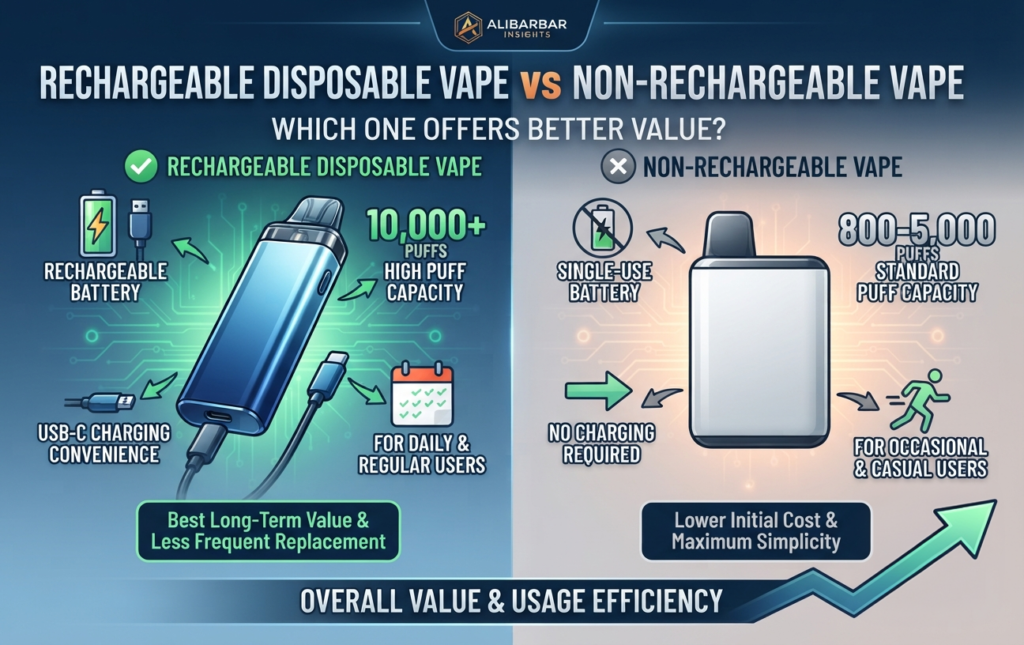
Rechargeable Disposable Vape vs Non-Rechargeable Vape: Which One Offers Better Value?
When choosing a disposable vape, one of the most important decisions is whether to choose a rechargeable disposable vape or a non-rechargeable disposable vape.
Traditional disposable vapes were designed around simplicity: use the device until the battery or e-liquid is finished, then replace it. However, as vape technology has developed, rechargeable disposable vapes have become increasingly popular, especially among users looking for longer usage, higher puff counts, and improved device efficiency.
But does rechargeable always mean better value?
The answer depends on several factors, including usage habits, device design, battery capacity, convenience, and overall experience.
This guide explains the differences between rechargeable and non-rechargeable disposable vapes and helps you understand which option may provide better value for different lifestyles.
What Is a Rechargeable Disposable Vape?
A rechargeable disposable vape is a disposable device that includes a built-in rechargeable battery, usually charged through a USB-C connection.
Unlike traditional disposable vapes, rechargeable models allow users to restore battery power while continuing to use the remaining e-liquid inside the device.
Typical features include:
- Built-in rechargeable lithium-ion battery
- USB-C charging port
- Larger e-liquid capacity
- Higher puff count
- Advanced power management systems
Rechargeable disposable vapes are commonly found in newer high-capacity devices because larger e-liquid volumes require more battery power to fully utilise the device.
What Is a Non-Rechargeable Disposable Vape?
A non-rechargeable disposable vape contains a pre-charged battery designed to last until the device reaches the end of its usable life.
The user does not need to charge the device.
Typical features include:
- Pre-charged battery
- Ready-to-use design
- Compact structure
- Simple operation
The main advantage of non-rechargeable disposable vapes is maximum convenience.
Users can simply open the package and start using the device without worrying about charging cables or battery levels.
Rechargeable vs Non-Rechargeable Disposable Vape: Key Differences
| Feature | Rechargeable Disposable Vape | Non-Rechargeable Disposable Vape |
| Battery | Rechargeable lithium-ion battery | Single-use battery |
| Charging | USB-C charging | No charging required |
| Usage period | Usually longer | Usually shorter |
| Puff capacity | Often higher | Usually lower |
| Convenience | Requires occasional charging | Ready immediately |
| Device size | Often larger | Usually more compact |
| Technology | More advanced | Simpler design |
| Best for | Regular users | Occasional users |
1. Battery Performance: Which One Lasts Longer?
Battery capacity is one of the biggest differences between these two categories.
Rechargeable disposable vapes usually contain larger batteries because they are designed to support:
- More heating cycles
- Larger e-liquid capacity
- Longer device lifespan
For example, a high-capacity disposable vape may contain enough e-liquid to provide thousands or even tens of thousands of puffs. A rechargeable battery helps ensure that the device can continue operating until the e-liquid is fully used.
Non-rechargeable disposable vapes use batteries designed around a shorter lifespan.
Their advantages include:
✓ Simpler design
✓ No charging management
✓ Immediate replacement convenience
However, the battery capacity must be carefully matched with the amount of e-liquid inside the device.
2. Usage Experience: Convenience vs Longevity
Both types of devices are designed for convenience, but they provide different experiences.
Rechargeable Disposable Vape Experience
Advantages:
✓ Longer usage period
✓ Less frequent replacement
✓ Better suited for daily users
✓ Supports larger device capacity
The main consideration is that users need to remember to recharge the device when battery power becomes low.
Non-Rechargeable Disposable Vape Experience
Advantages:
✓ Extremely simple operation
✓ No charging required
✓ Ideal for quick and occasional use
The trade-off is that the device has a fixed battery lifespan.
3. Puff Count: Why Rechargeable Devices Usually Offer More
High puff disposable vapes commonly use rechargeable batteries because larger e-liquid reservoirs require more power.
A device advertised with:
- 5,000 puffs
- 9,000 puffs
- 15,000 puffs
- 20,000 puffs
requires careful balance between:
- Battery capacity
- Coil efficiency
- Power output
- E-liquid consumption
Rechargeable technology allows manufacturers to increase device capacity without the battery becoming the limiting factor.
4. Cost Efficiency: Which Provides Better Value?
The value of a disposable vape depends on more than the purchase price.
A non-rechargeable vape may have:
- Lower initial cost
- Smaller capacity
- More frequent replacement needs
A rechargeable disposable vape may have:
- Higher initial cost
- Longer usage period
- More puffs per device
For regular users, rechargeable disposable vapes may provide better value because one device can last significantly longer.
For occasional users, a smaller non-rechargeable device may be more practical.
5. Portability: The Advantage of Non-Rechargeable Devices
One area where non-rechargeable disposable vapes often perform well is portability.
Their simpler design allows manufacturers to create:
- Smaller devices
- Lighter designs
- More compact shapes
This makes them convenient for:
- Short trips
- Occasional use
- Users who prefer minimal carrying weight
Rechargeable disposable vapes are often slightly larger because they require:
- Larger batteries
- Charging components
- More advanced internal systems
However, many modern rechargeable designs are still highly portable.
6. Flavour Consistency and Performance
Battery performance directly affects flavour consistency.
A stable power supply helps the heating element maintain consistent performance.
Rechargeable disposable vapes often include:
- Improved battery management
- Advanced heating systems
- Mesh coil technology
- Optimized airflow designs
These features help deliver a more consistent experience throughout the device lifespan.
Non-rechargeable disposable vapes can also provide excellent flavour performance, especially when the battery capacity is well matched with the e-liquid volume.
The difference is mainly related to device capacity and technology integration.
7. Environmental Considerations
Environmental impact is an increasingly important consideration for consumers.
Rechargeable Disposable Vape
Potential advantages:
- Longer usage per device
- Fewer replacements required
- Better efficiency for high-capacity products
However, the device still contains electronic components and should be disposed of responsibly.
Non-Rechargeable Disposable Vape
Potential concerns:
- More frequent replacement
- More batteries used over time
- Higher volume of discarded devices
Responsible recycling and disposal practices are important for both types of products.
8. Safety and Battery Management
Both rechargeable and non-rechargeable disposable vapes use battery technology that requires proper handling.
Recommended practices:
✓ Avoid exposing devices to extreme temperatures
✓ Keep devices away from moisture
✓ Do not use damaged devices
✓ Follow manufacturer charging instructions for rechargeable models
For rechargeable devices:
- Use appropriate charging equipment
- Avoid leaving devices charging unattended
- Disconnect after charging is complete
How Modern Rechargeable Disposable Vapes Are Changing the Market
Rechargeable disposable vapes represent a major development in disposable vape technology.
Earlier disposable devices focused mainly on:
- Compact size
- Simple operation
- Short-term convenience
Modern rechargeable disposable vapes combine:
- Larger battery systems
- Higher e-liquid capacity
- USB-C charging
- Advanced heating technology
- Improved airflow design
Products such as the ALIBARBAR INGOT series represent this new generation of disposable devices, focusing on balancing capacity, performance, and convenience.
The purpose of rechargeable technology is not simply to add charging capability—it allows the entire device system to operate more efficiently.
Which One Offers Better Value?
The answer depends on your lifestyle.
Choose a Rechargeable Disposable Vape if you prefer:
✓ Longer device lifespan
✓ Higher puff capacity
✓ Fewer replacements
✓ Better long-term value
✓ Advanced features
Choose a Non-Rechargeable Disposable Vape if you prefer:
✓ Maximum simplicity
✓ No charging required
✓ Smaller device size
✓ Occasional usage
✓ Immediate convenience
Final Thoughts
Rechargeable and non-rechargeable disposable vapes both have advantages.
Non-rechargeable devices remain popular because they offer unmatched simplicity and convenience.
Rechargeable disposable vapes, however, represent the next generation of disposable vape technology, offering higher capacity, improved efficiency, and longer-lasting performance.
For regular users who want more usage from a single device, rechargeable disposable vapes often provide better overall value.
For occasional users who prioritise simplicity and portability, traditional non-rechargeable disposable vapes may still be the ideal choice.
The best option is not necessarily the most powerful device—it is the one that best matches your lifestyle, usage habits, and expectations.
References & Data Sources
- Battery University – Lithium-Ion Battery Capacity, Charging and Performance Information
https://batteryuniversity.com - U.S. Food and Drug Administration (FDA) – Battery Safety Tips and Lithium-Ion Battery Information
https://www.fda.gov/consumers/consumer-updates/battery-safety-tips - International Electrotechnical Commission (IEC) – Lithium Battery Safety Standards and Guidelines
https://www.iec.ch - National Academies of Sciences, Engineering, and Medicine – Public Health Consequences of E-Cigarettes (Electronic Cigarette Device Characteristics)
https://nap.nationalacademies.org/catalog/24952/public-health-consequences-of-e-cigarettes - U.S. Consumer Product Safety Commission (CPSC) – Lithium-Ion Battery Safety Information
https://www.cpsc.gov/Safety-Education/Safety-Education-Centers/Lithium-Ion-Batteries - Journal of Power Sources – Lithium-Ion Battery Performance, Efficiency and Energy Storage Research
https://www.sciencedirect.com/journal/journal-of-power-sources - Australian Competition & Consumer Commission (ACCC) – Product Safety Information
https://www.productsafety.gov.au