
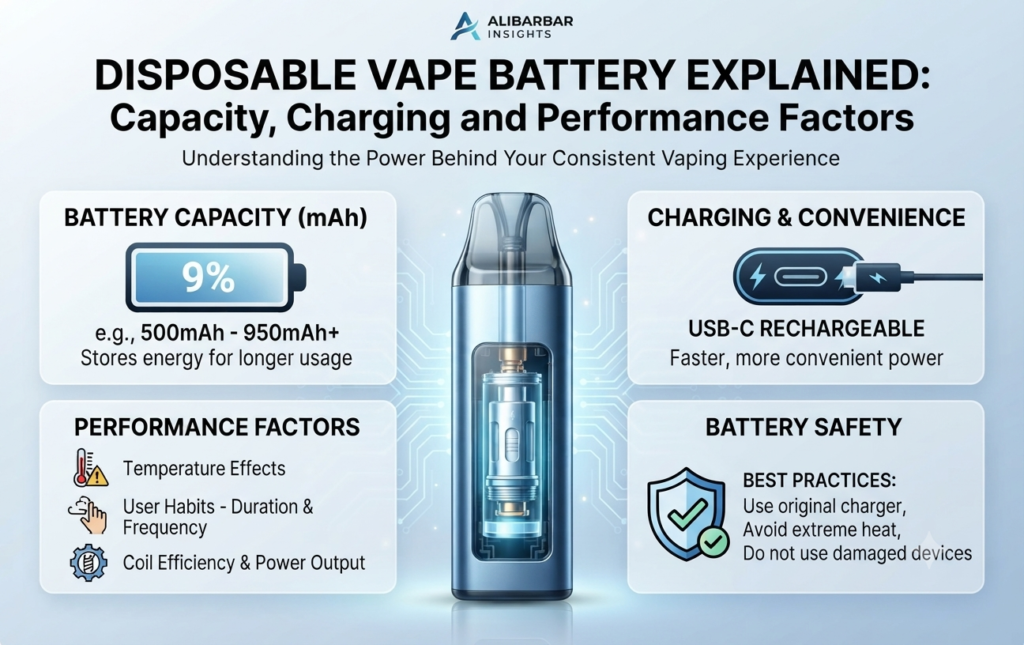
Disposable Vape Battery Explained: Capacity, Charging and Performance Factors
When choosing a disposable vape, many users focus on flavour, puff count, and design. However, the battery is one of the most important components that determines the overall vaping experience.
The battery powers the heating system, controls vapour production, and influences how consistently a device performs throughout its lifespan.
Understanding disposable vape battery technology can help users better understand why different devices perform differently and what factors affect battery life, charging efficiency, and overall performance.
The Role of the Battery in a Disposable Vape
A disposable vape battery provides the energy needed to heat the coil and vaporise e-liquid.
The basic process works as follows:
- The user activates the device by inhaling.
- The battery sends electrical power to the heating element.
- The coil heats the e-liquid.
- Vapour is produced and delivered through the airflow system.
Although disposable vapes appear simple from the outside, modern devices require carefully balanced battery systems to maintain consistent performance.
The battery affects:
- Vapour production
- Heating speed
- Flavour consistency
- Device lifespan
- Overall reliability
Understanding Vape Battery Capacity
Battery capacity is usually measured in milliamp hours (mAh).
The mAh rating indicates how much electrical energy a battery can store.
Generally:
- Higher mAh capacity = more available energy
- Lower mAh capacity = shorter operating time
However, battery capacity alone does not determine how long a disposable vape lasts.
Actual performance depends on several factors:
- Battery capacity
- Coil resistance
- Power output
- E-liquid volume
- User puff frequency
- Puff duration
A larger battery can support longer usage, but the entire device system must be designed efficiently.
Battery Capacity and Puff Count: Why They Are Connected
Many disposable vapes advertise a specific puff count, such as:
- 5,000 puffs
- 9,000 puffs
- 20,000 puffs
However, puff numbers are based on controlled testing conditions and can vary depending on individual usage habits.
Factors that influence actual puff performance include:
Puff Duration
Longer puffs consume more energy and e-liquid compared with shorter puffs.
Usage Frequency
Frequent use requires more battery power over a shorter period.
Device Technology
Advanced heating systems and power management can improve efficiency.
Rechargeable vs Non-Rechargeable Disposable Vape Batteries
Disposable vapes can generally be divided into two categories:
Non-Rechargeable Disposable Vapes
Traditional disposable vapes contain a built-in battery designed to last until the e-liquid is finished.
Advantages:
✓ Simple operation
✓ No charging required
✓ Ready to use immediately
Limitations:
- Battery capacity must match e-liquid volume
- Less flexibility once battery power is depleted
Rechargeable Disposable Vapes
Many modern disposable vapes include USB-C charging.
Advantages:
✓ Supports larger e-liquid capacities
✓ Helps ensure battery power matches e-liquid usage
✓ Extends usable device life
Rechargeable systems are becoming increasingly common because high-capacity devices require more energy to support longer usage periods.
Why USB-C Charging Has Become Popular
USB-C charging has become a common feature in modern disposable vape designs.
Compared with older charging methods, USB-C offers:
- Faster charging capability
- More convenient connection
- Improved compatibility with modern devices
For high-capacity disposable vapes, rechargeable designs help maintain a balance between battery capacity and e-liquid capacity.
Without rechargeable capability, the battery may become depleted before the available e-liquid is fully used.
Factors That Affect Disposable Vape Battery Performance
1. Temperature
Temperature has a significant impact on lithium-ion battery performance.
Extreme conditions may affect:
- Battery efficiency
- Charging performance
- Overall lifespan
Avoid:
❌ Leaving devices in direct sunlight
❌ Storing in hot vehicles
❌ Exposing devices to extreme cold
Recommended:
✓ Store at normal room temperature
✓ Keep away from heat sources
✓ Protect from moisture
2. Power Output Management
The battery must provide consistent power to the heating element.
If power delivery is unstable, users may notice:
- Inconsistent vapour production
- Changing flavour intensity
- Reduced performance
Modern devices use improved electronic control systems to help maintain more stable output.
3. Coil Technology
The relationship between the battery and coil is critical.
A powerful battery combined with an inefficient heating system may waste energy.
Modern mesh coil systems are designed to provide:
- Faster heating response
- More even heating
- Improved energy efficiency
This allows manufacturers to optimize battery usage while maintaining flavour performance.
4. User Vaping Habits
Battery consumption depends heavily on how a device is used.
Factors include:
Longer puffs
Use more energy per activation.
Frequent vaping
Requires more repeated heating cycles.
Strong inhalation
May activate the device for longer periods.
Moderate usage habits can help maintain more consistent performance.
How Battery Technology Has Improved Disposable Vapes
Early disposable vapes were designed for short-term convenience with relatively simple battery systems.
Modern disposable vapes have introduced improvements such as:
Higher-capacity batteries
Allowing longer device operation.
Better power management
Helping maintain consistent output.
Rechargeable designs
Supporting larger e-liquid capacities.
Improved safety systems
Including protection features for battery operation.
These developments have helped transform disposable vapes into more advanced electronic devices.
Battery Safety: Best Practices for Vape Users
Although disposable vape batteries are designed for everyday use, proper handling remains important.
Recommended practices:
✓ Use the original charging method when applicable
✓ Avoid charging unattended
✓ Keep devices away from water
✓ Do not use damaged devices
✓ Store away from extreme temperatures
Avoid:
❌ Using damaged batteries
❌ Exposing devices to excessive heat
❌ Modifying internal components
How ALIBARBAR Uses Battery Technology for Consistent Performance
High-capacity disposable vapes require careful integration between:
- Battery capacity
- Heating technology
- E-liquid volume
- Airflow design
The ALIBARBAR INGOT series is designed around this balance, combining:
- High-capacity battery systems
- Advanced heating technology
- Optimized power delivery
- Large e-liquid capacity
The purpose of battery technology is not simply to provide more power, but to maintain a stable and consistent experience throughout the device lifespan.
How to Choose a Disposable Vape Based on Battery Performance
When comparing disposable vapes, consider more than just the advertised puff count.
Look at:
Battery Capacity
A suitable battery should match the device’s e-liquid capacity.
Charging Capability
Rechargeable devices may provide more flexibility for high-capacity products.
Power Management
Stable output helps maintain flavour and vapour consistency.
Device Quality
Battery performance depends on the entire device design, not one individual component.
Frequently Asked Questions
Does a bigger battery mean more puffs?
Not necessarily.
Puff count depends on battery capacity, e-liquid volume, coil technology, power output, and user habits.
Why does my vape battery drain quickly?
Possible reasons include:
- Frequent usage
- Long puff duration
- High power consumption
- Battery ageing
- Extreme temperatures
Can I recharge any disposable vape?
No.
Only devices specifically designed with rechargeable batteries should be charged.
Always follow manufacturer instructions.
Does charging improve vape performance?
For rechargeable disposable vapes, charging restores battery power and helps maintain normal operation.
However, charging cannot restore a device that has already reached the end of its e-liquid supply or lifespan.
Final Thoughts
The battery is one of the most important technologies inside a disposable vape.
From capacity and charging systems to power management and temperature control, battery design directly influences the consistency and reliability of the vaping experience.
As disposable vape technology continues to evolve, manufacturers are focusing on creating smarter, more efficient battery systems that work together with heating technology and airflow design.
A well-balanced battery does not simply provide more power—it helps deliver a smoother, more consistent experience from the first puff to the last.
References & Data Sources
- Battery University – Lithium-Ion Battery Fundamentals, Capacity and Storage Performance
https://batteryuniversity.com - U.S. Food and Drug Administration (FDA) – Battery Safety Tips and Lithium-Ion Battery Information
https://www.fda.gov/consumers/consumer-updates/battery-safety-tips - International Electrotechnical Commission (IEC) – Lithium Battery Safety Standards
https://www.iec.ch - National Academies of Sciences, Engineering, and Medicine – Public Health Consequences of E-Cigarettes (Electronic Cigarette Device Characteristics)
https://nap.nationalacademies.org/catalog/24952/public-health-consequences-of-e-cigarettes - Journal of Power Sources – Research on Lithium-Ion Battery Performance and Energy Efficiency
https://www.sciencedirect.com/journal/journal-of-power-sources - U.S. Consumer Product Safety Commission (CPSC) – Lithium-Ion Battery Safety Information
https://www.cpsc.gov/Safety-Education/Safety-Education-Centers/Lithium-Ion-Batteries