
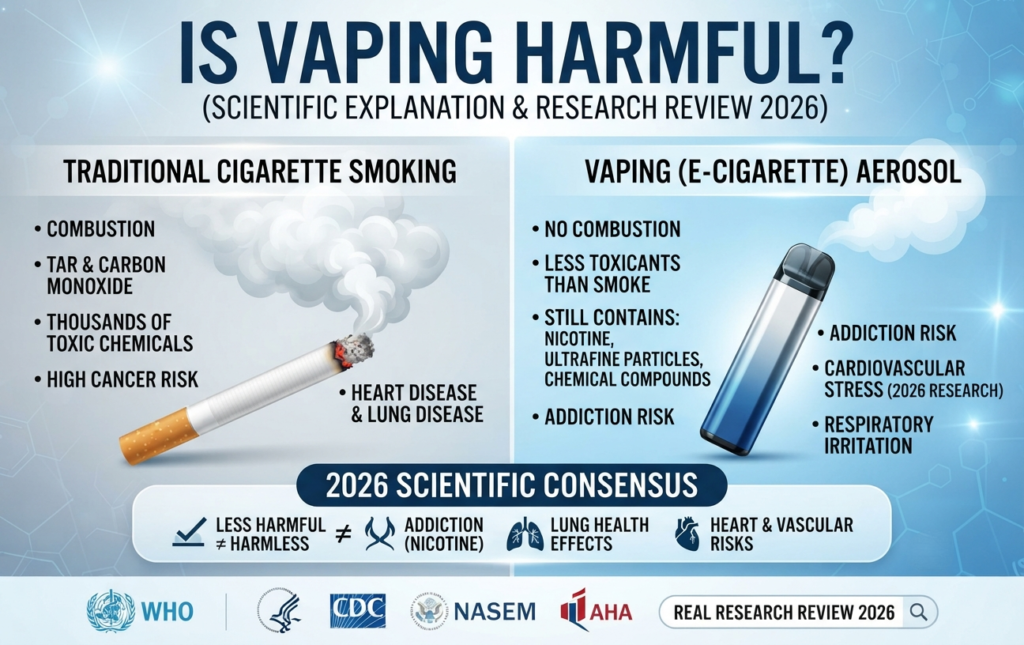
Is Vaping Harmful? Scientific Explanation & Real Research Review (2026)
Introduction
Vaping (using e-cigarettes or disposable vapes) has become widely popular worldwide, especially among smokers and young adults. A key question is: is vaping harmful?
Current scientific evidence shows that vaping is not harmless, but it is generally considered less harmful than traditional cigarette smoking in terms of toxic exposure.
This article explains the scientific consensus, compares vaping with smoking, describes nicotine effects, and corrects common misconceptions.
1. Scientific Research Findings on Vaping
Current scientific consensus
Most major health authorities agree on the following:
Vaping exposes users to fewer toxic chemicals than cigarette smoke
However, vaping still introduces harmful substances into the body
Long-term health effects are still being studied
Key findings from research:
E-cigarette aerosol contains nicotine, heavy metals, and chemical compounds
Some substances in vape aerosol are linked to cardiovascular and respiratory risks
Long-term exposure may increase risk of chronic disease
Recent medical research (2026) also indicates potential links between vaping chemicals and heart and vascular damage, suggesting ongoing health risks rather than harmless exposure.
2. Vaping vs Cigarettes: Health Comparison
Cigarettes:
Contain tar and carbon monoxide
Produce smoke through combustion
Contain thousands of toxic chemicals
Strongly linked to cancer, lung disease, and heart disease
Vaping:
No combustion (no burning tobacco)
Typically contains fewer toxic chemicals
Still contains nicotine and aerosolized compounds
Key scientific conclusion:
Vaping is generally considered less harmful than smoking
But it is not safe or risk-free
Even non-combustion aerosols still expose lungs to substances that are not naturally inhaled.
3. Nicotine: Its Role and Effects
Nicotine is the primary addictive substance in most vaping products.
Scientific facts about nicotine:
Highly addictive chemical
Acts on the brain’s reward system (dopamine release)
Can increase heart rate and blood pressure
Affects adolescent brain development
Key concerns:
Strong dependency potential
Reinforcement of habitual use
Increased difficulty quitting nicotine once dependence forms
Nicotine itself is not the main cause of cancer in smoking, but it contributes to addiction and cardiovascular stress.
4. Common Misconceptions About Vaping
Misconception 1: “Vaping is just water vapor”
❌ Incorrect
Vape aerosol contains:
Nicotine (often)
Propylene glycol (PG)
Vegetable glycerin (VG)
Flavoring chemicals
Trace metals from heating coils
It is not water vapor.
Misconception 2: “Vaping is completely safe”
❌ Incorrect
Scientific studies show:
It is not harmless
It may still affect lungs, heart, and blood vessels
Long-term risks are still under investigation
Misconception 3: “No nicotine means no risk”
❌ Incorrect
Even nicotine-free liquids may produce:
Heated chemical byproducts
Irritating aerosol particles
Inhalation-related lung stress
5. What Science Still Does NOT Fully Know
Because vaping is relatively new (compared to cigarettes), researchers are still studying:
Long-term cancer risk
Effects of chronic lung exposure
Impact of flavoring chemicals
Effects of high-frequency usage (modern disposables)
Most studies agree that long-term data (10–30 years) is still limited.
6. Summary of Health Risks
Known risks:
Nicotine addiction
Cardiovascular stress
Respiratory irritation
Exposure to toxic compounds
Uncertain risks:
Long-term cancer risk
Chronic lung disease development
Effects of modern high-strength disposable vapes
7. Conclusion
Vaping is not harmless. Scientific evidence shows it exposes users to fewer harmful chemicals than smoking, but it still carries meaningful health risks, especially due to nicotine and aerosol inhalation.
For adult smokers, vaping may be considered a harm-reduction alternative, but for non-smokers, it introduces unnecessary exposure to addictive and potentially harmful substances.
Scientific & Data Sources (References)
Public Health Authorities
World Health Organization (WHO) – Electronic cigarettes and health effects overview
Centers for Disease Control and Prevention (CDC) – Health effects of e-cigarettes
UK National Health Service (NHS) – Vaping facts and smoking cessation guidance
Australian Therapeutic Goods Administration (TGA) – Nicotine vaping regulation framework
Major Scientific Reviews
National Academies of Sciences, Engineering, and Medicine (NASEM, 2018)
Public health consequences of e-cigarettes review
Medical & Academic Research
Journal studies in Tobacco Control and Carcinogenesis
(chemical exposure, aerosol toxicity, and carcinogen-related mechanisms)
American Heart Association (2026 scientific statements)
(links between vaping chemicals and cardiovascular risk)
Key Scientific Consensus Points
Vaping aerosol contains fewer toxicants than cigarette smoke but is not harmless (NASEM, CDC, NHS)
Nicotine is highly addictive and affects brain development (CDC, WHO)
Long-term health outcomes are still under ongoing research (WHO, CDC)