
The Evolution of Vaping Culture in Australia
A Complete Overview of Vape History Australia and Changing Consumer Trends
Understanding Vaping Culture in Australia
The story of vaping culture in Australia reflects a broader global shift in consumer technology, public health discussions, and changing attitudes toward nicotine consumption.
Since electronic cigarettes first appeared internationally in the early 2000s, vaping has evolved from a niche technology used by early adopters into a widely recognized consumer product category.
Australia has experienced its own unique journey, shaped by technological innovation, changing consumer behaviour, public discussions, and evolving regulatory frameworks.
Understanding the vape history Australia provides valuable insight into how vaping products developed, how user demographics changed, and how modern devices became significantly different from early electronic cigarette designs.
1. The Beginning of Vaping in Australia
When Did Vaping Enter the Australian Market?
Electronic cigarettes began appearing in Australia during the mid-to-late 2000s, following their introduction in international markets.
Early vaping devices were relatively simple compared with modern products. Most early devices were designed to resemble traditional cigarettes and were commonly known as:
Cig-a-likes
First-generation electronic cigarettes
Basic battery-powered vapour devices
These early products generally consisted of three main components:
A small rechargeable battery
A heating element (atomiser)
A cartridge containing liquid
The primary appeal among early users was the development of a new electronic technology that could provide an alternative experience compared with traditional cigarette products.
2. The Early Vaping Community in Australia
During the early stages, Australian vaping communities were relatively small and mainly consisted of:
Adult smokers exploring alternative products
Technology enthusiasts
Online discussion communities
Hobbyist users interested in device modification
Unlike traditional tobacco products, vaping developed a strong online culture.
Users shared information about:
Device performance
Battery technology
Flavour preferences
Hardware improvements
Product reviews
Online communities played an important role in spreading knowledge about vaping devices and creating early vaping culture in Australia.
3. The Growth of Vaping Culture During the 2010s
From Cigarette-Style Devices to Advanced Hardware
During the 2010s, vaping technology changed significantly.
Second-generation devices introduced:
Larger rechargeable batteries
Refillable tanks
Improved heating systems
Adjustable power settings
Greater user control
These developments transformed vaping from a simple electronic cigarette replacement into a technology-focused consumer product category.
Many users became interested in:
Device design
Product performance
Flavour selection
Personal preferences
User experience
The vaping community expanded from early technology enthusiasts into a wider group of adult consumers interested in different types of devices.
4. The Rise of Disposable Vape Technology
How Disposable Vapes Changed the Market
One of the biggest changes in vape history Australia was the growth of disposable vape technology.
Compared with traditional refillable systems, disposable devices focused on:
Convenience
Portability
Simple operation
Consistent design
Modern disposable vape products combine several technologies:
Integrated battery systems
Pre-filled liquid chambers
Compact product designs
Improved airflow systems
The simplified user experience helped disposable vape devices become one of the most recognised categories within the global vaping market.
5. Changes in Australian Vape User Demographics
From Hobby Users to Mainstream Consumers
The profile of vape users has changed over time.
Early users were mainly:
Adult smokers
Technology-focused consumers
Online community members
As technology improved, vaping products became more accessible and easier to use.
Several factors influenced this change:
1. Product Accessibility
Modern devices became easier to operate compared with early-generation products that required more technical knowledge.
2. Product Design Improvements
Manufacturers increasingly focused on:
Smaller designs
Better portability
Improved user experience
More product choices
3. Digital Communities
Social media platforms and online communities contributed to increased awareness of vaping products and changing consumer conversations.
6. The Evolution of Vape Technology
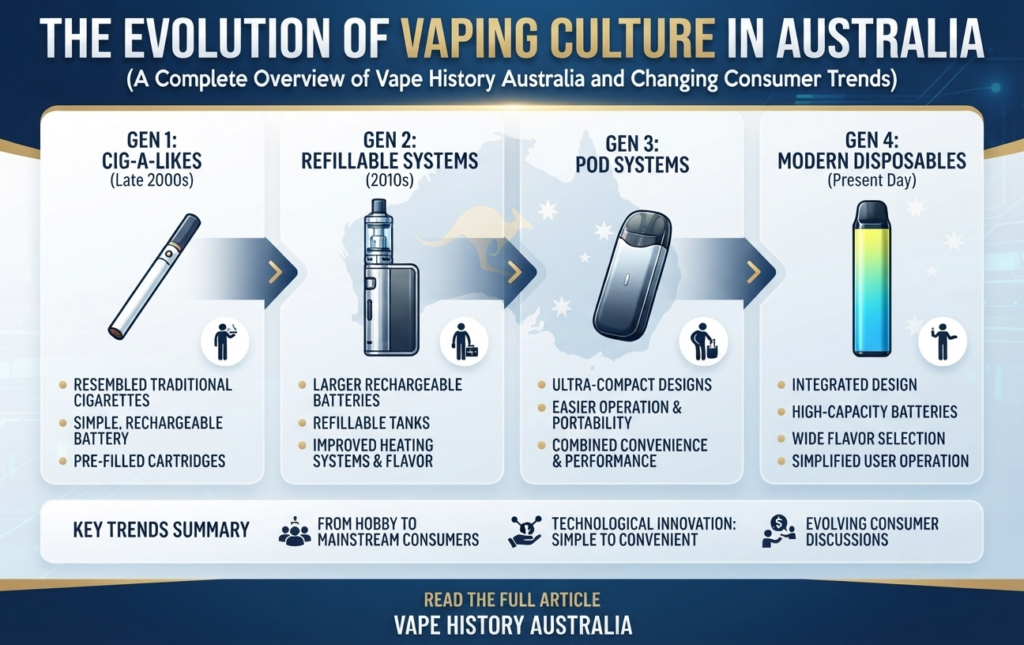
Generation 1: Cigarette-Style Devices
Characteristics:
Small battery capacity
Simple cartridge systems
Limited performance
Main purpose:
To create a familiar experience similar to traditional cigarettes.
Generation 2: Refillable Vape Systems
Characteristics:
Larger batteries
Refillable tanks
Adjustable settings
Main purpose:
To provide greater flexibility and personalisation.
Generation 3: Pod Systems
Characteristics:
Compact designs
Easier operation
Portable formats
Main purpose:
To combine convenience with improved performance.
Generation 4: Modern Disposable Vape Devices
Characteristics:
Integrated design
Higher-capacity batteries
Multiple flavour categories
Simple user operation
Main purpose:
To provide a convenient and consistent consumer experience.
7. The Role of Technology in Shaping Modern Vaping Culture
Technology has been one of the biggest drivers behind the evolution of vaping.
Modern vape development focuses on several areas:
Battery Innovation
Advancements in battery technology have allowed manufacturers to create smaller devices while maintaining longer operating times.
Heating Technology
Improved atomisation systems aim to provide more consistent vapour production and improved device reliability.
Product Design Innovation
Modern vape devices increasingly focus on:
Ergonomic shapes
Lightweight materials
Portable designs
User-friendly operation
8. The Future of Vaping Culture in Australia
The future development of vaping culture in Australia will continue to be influenced by:
Scientific research
Public health policies
Consumer behaviour
Technology development
The history of vaping demonstrates a transition from simple electronic cigarette alternatives into a technology category shaped by engineering innovation, consumer preferences, and social trends.
Understanding the vape history Australia helps explain how vaping evolved from early experimental devices into modern electronic products with advanced designs and changing consumer expectations.
Frequently Asked Questions (FAQ)
What is vaping culture in Australia?
Vaping culture in Australia refers to the communities, consumer behaviours, technology trends, and social discussions surrounding electronic vaping products.
When did vaping start in Australia?
Electronic cigarettes began appearing in Australia during the mid-to-late 2000s, following their introduction in international markets.
How has vape technology changed?
Vape technology has evolved from simple cigarette-style devices into advanced systems including refillable devices, pod systems, and modern integrated designs.
Why did disposable vape devices become popular?
Disposable vape devices became popular because of their simplified operation, portability, and consistent product design.
References and Scientific Sources
World Health Organization (WHO)
Electronic Nicotine Delivery Systems (ENDS) Reports
Research focus:
Global development of electronic nicotine delivery systems
Public health discussions
Regulatory considerations
Website:
Australian Institute of Health and Welfare (AIHW)
Australian National Drug Strategy Household Survey
Research focus:
Australian smoking behaviour trends
Nicotine product usage patterns
Population-level data
Website:
Australian Department of Health and Aged Care
Research focus:
Australian vaping regulations
Nicotine product policies
Public health information
Website:
National Academies of Sciences, Engineering, and Medicine (NASEM)
Report:
Public Health Consequences of E-Cigarettes (2018)
Research focus:
E-cigarette technology
Chemical exposure
Scientific evidence evaluation
Website:
https://www.nationalacademies.org
Cochrane Library
Research focus:
Evidence reviews on electronic cigarettes
Clinical research
Smoking cessation studies
Website: