
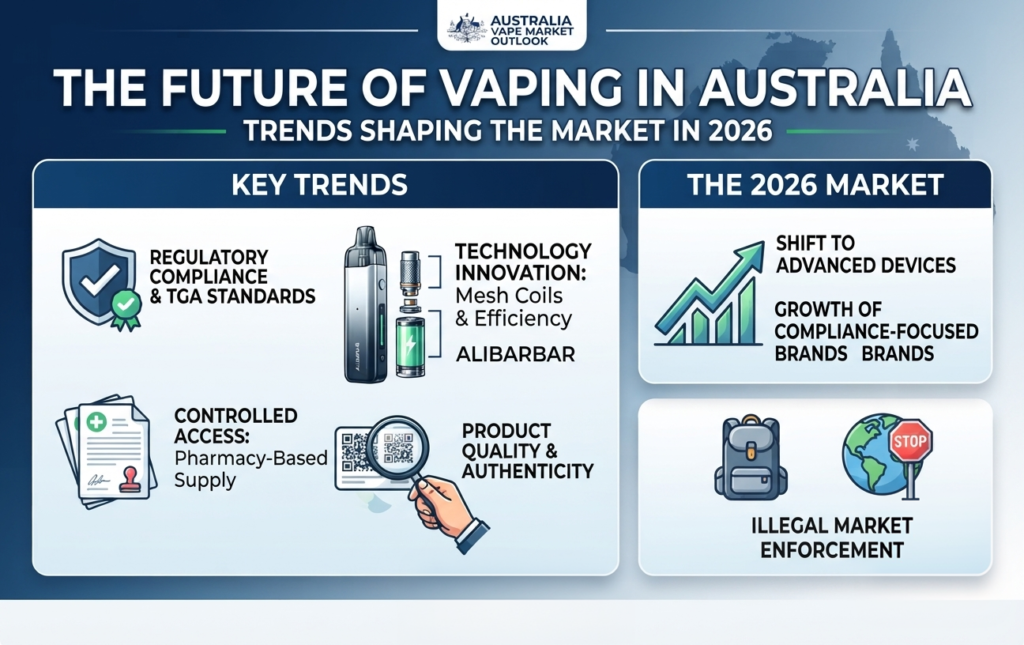
The Future of Vaping in Australia: Trends Shaping the Market in 2026
The Australian vaping market is entering a new phase in 2026.
Unlike many international markets where vaping products continue to develop mainly around consumer choice and retail competition, Australia is moving toward a highly regulated model focused on controlled access, product standards, and compliance.
For brands, retailers, and adult consumers, the future of vaping in Australia will not simply depend on product popularity. Success will increasingly rely on:
- Regulatory compliance
- Product quality
- Technology innovation
- Consumer trust
- Responsible supply chains
As the industry continues to evolve, several key trends are shaping the future of vaping in Australia.
1. A More Regulated Vape Market
The biggest change shaping Australia’s vaping future is regulation.
Since major vaping reforms began in 2024, Australia has moved toward a controlled supply model where vaping products are regulated as therapeutic goods rather than ordinary consumer products.
Under the current framework:
- Legal supply channels are restricted
- Pharmacy-based access has become central
- Importation and commercial supply are monitored
- Non-compliant products face enforcement action
The Therapeutic Goods Administration (TGA), together with Australian Border Force and state authorities, continues to strengthen compliance activities across the supply chain.
This means the future Australian vape market will likely become more focused on:
✓ Compliance
✓ Transparency
✓ Product standards
✓ Responsible distribution
rather than unrestricted retail availability.
2. The Rise of Compliance-Focused Brands
In previous years, the global vape market expanded rapidly through convenience-focused products.
However, Australia’s regulatory environment is creating a different competitive landscape.
Future success will increasingly favour brands that can demonstrate:
- Manufacturing consistency
- Reliable product information
- Regulatory awareness
- Supply chain transparency
Brands entering the Australian market will need to move away from informal distribution models and develop stronger compliance systems.
The future market advantage will not only come from having attractive products, but from building consumer confidence.
3. Technology Will Become a Key Differentiator
As regulations become stricter, product innovation will become more important.
Future vape products are expected to compete through technology improvements rather than simply increasing availability.
Key technology trends include:
Advanced Heating Systems
Modern disposable vape devices increasingly use technologies such as mesh coil systems.
Advantages include:
- More consistent heating
- Improved flavour delivery
- Better vapour stability
Heating technology will continue to influence how brands differentiate their products.
Battery Efficiency Improvements
Battery performance remains one of the most important areas of vape innovation.
Future devices are likely to focus on:
- Better energy management
- More efficient power delivery
- Longer usable performance
The goal will be creating devices that provide reliable performance throughout their intended lifespan.
Improved Airflow Engineering
Airflow design affects:
- Vapour smoothness
- Flavour intensity
- Overall user experience
Future vape products will continue improving airflow systems to create more balanced experiences.
4. The Shift From Disposable Products to Advanced Devices
One major trend in global vaping is the evolution from simple disposable devices toward more sophisticated systems.
Traditional disposable vapes focused on:
- Low cost
- Simple operation
- Short-term convenience
Modern devices increasingly focus on:
- Higher capacity
- Better technology
- Premium design
- Improved performance
In Australia, this transition is likely to accelerate because regulations are pushing the market toward more controlled and standardised products.
5. Product Quality Will Become More Important Than Price
In less regulated markets, price competition often dominates.
However, in Australia’s future vape market, quality is expected to become a stronger purchasing factor.
Consumers are likely to pay more attention to:
Authenticity
Users will increasingly want confidence that products are genuine and compliant.
Manufacturing Standards
Important factors include:
- Battery safety
- Product consistency
- Clear information
Brand Reputation
As illegal and non-compliant products continue to face enforcement pressure, trusted brands may gain stronger recognition.
6. Flavour Innovation Will Continue Evolving
Flavour remains one of the most important parts of the vaping experience.
However, flavour development in Australia will increasingly operate within regulatory boundaries.
Future trends may include:
- More refined flavour profiles
- Better flavour consistency
- Improved formulation technology
- Greater focus on adult consumer preferences
Rather than simply offering unlimited flavour choices, successful brands will likely focus on creating high-quality, balanced experiences.
7. Consumer Education Will Become More Important
Australia’s complex vaping regulations mean consumer education will play a larger role.
Adult users increasingly need to understand:
- Legal purchasing pathways
- Product compliance
- Nicotine regulations
- Responsible usage
Government agencies continue providing information about legal supply pathways and regulatory requirements.
The future market will depend not only on products but also on how well consumers understand the changing environment.
8. The Growth of Pharmacy-Based Access
Australia’s vaping system is becoming increasingly centred around pharmacies.
Since regulatory changes:
- Therapeutic vapes are supplied through approved channels
- Pharmacy involvement has increased
- Healthcare guidance has become more important
This represents a significant shift compared with markets where vaping products are sold through specialist stores and convenience retailers.
Future brands may need to consider how their products fit into a more healthcare-oriented supply environment.
9. Illegal Market Enforcement Will Shape the Industry
One of the biggest challenges facing Australia’s vape market is illegal supply.
Authorities continue targeting:
- Unauthorised imports
- Illegal retail sales
- Non-compliant products
Australian Border Force has increased enforcement activity against prohibited vaping imports, including devices and nicotine-containing products entering without required permissions.
This creates two possible outcomes:
Short Term
The market may experience disruption as illegal supply networks are targeted.
Long Term
A stronger compliance environment may benefit legitimate brands that operate transparently.
10. Sustainability and Product Responsibility
Environmental concerns are becoming increasingly important globally.
Disposable electronic products create challenges related to:
- Battery waste
- Electronic components
- Material recycling
Future vape technology may place more attention on:
- Longer-lasting devices
- Better battery efficiency
- Responsible disposal systems
Sustainability may become another factor influencing consumer choices.
How ALIBARBAR Represents Future Vape Trends
The development direction of brands like ALIBARBAR reflects several broader industry trends.
Modern vape products are moving toward:
Technology-Driven Design
Including:
- Advanced coil systems
- Improved battery performance
- Optimised airflow
Premium User Experience
Consumers increasingly value:
- Product appearance
- Comfort
- Flavour quality
- Reliability
Longer-Term Performance
High-capacity devices represent the shift from basic disposable products toward more engineered experiences.
The future competition will increasingly focus on product quality rather than simply offering more products.
Challenges Facing the Australian Vape Industry
Despite technological progress, the industry will continue facing challenges.
These include:
Regulatory Complexity
Brands must continuously monitor changing requirements.
Consumer Access Restrictions
Limited supply channels may influence purchasing behaviour.
Illegal Competition
Unregulated products remain a challenge for enforcement agencies.
Public Perception
The vaping industry must continue addressing concerns around youth access and responsible use.
What Will Define Successful Vape Brands in Australia?
By 2026 and beyond, successful brands will likely share several characteristics:
1. Strong Compliance
Following Australian regulations will become essential.
2. High Product Quality
Consumers will increasingly value reliability over low prices.
3. Technology Innovation
Better engineering will become a major competitive advantage.
4. Consumer Trust
Brands that communicate clearly and operate responsibly will have stronger long-term potential.
Final Thoughts
The future of vaping in Australia is moving toward a more regulated, technology-driven, and quality-focused market.
The industry of the past was defined by rapid product expansion.
The industry of the future will be defined by:
✓ Compliance
✓ Innovation
✓ Product quality
✓ Responsible distribution
✓ Consumer trust
For brands, the opportunity remains significant—but success will require adapting to Australia’s unique regulatory environment.
As vaping continues to evolve in 2026 and beyond, the companies that combine advanced technology with responsible business practices will be best positioned to succeed in the Australian market.
References & Data Sources
- Therapeutic Goods Administration (TGA) – Vapes: Compliance and Enforcement
https://www.tga.gov.au - Therapeutic Goods Administration (TGA) – Lawful Possession and Supply of Vaping Goods in Australia
https://www.tga.gov.au - Australian Border Force – Vaping Goods and Nicotine Import Restrictions
https://www.abf.gov.au - Australian Institute of Health and Welfare (AIHW) – Vaping and E-cigarettes in Australia
https://www.aihw.gov.au - National Drug Strategy Household Survey – Tobacco, E-cigarettes and Other Nicotine Insights
https://www.aihw.gov.au - National Academies of Sciences, Engineering, and Medicine – Public Health Consequences of E-Cigarettes
https://nap.nationalacademies.org/catalog/24952/public-health-consequences-of-e-cigarettes - Centers for Disease Control and Prevention (CDC) – Electronic Cigarettes and Vaping Information
https://www.cdc.gov/tobacco/basic_information/e-cigarettes/ - Journal of Aerosol Science – Electronic Cigarette Aerosol and Device Performance Research
https://www.sciencedirect.com/journal/journal-of-aerosol-science