
Understanding Vape Airflow: How Different Designs Affect Your Vaping Experience
When choosing a disposable vape, most users focus on flavour, puff count, battery capacity, and design. However, one of the most important factors affecting the overall vaping experience is often overlooked: airflow design.
Airflow controls how air moves through the device when you inhale. It influences vapour density, flavour intensity, throat sensation, and the overall smoothness of each puff.
A well-designed airflow system helps balance air and vapour, creating a more consistent experience from the first puff to the last.
In this guide, we explain how vape airflow works, the different airflow designs available, and how they affect your vaping experience.
What Is Vape Airflow?
Airflow refers to the movement of air through a vape device during inhalation.
When you take a puff, air enters through airflow openings, passes through the heating chamber, mixes with vaporised e-liquid, and then travels through the mouthpiece.
The airflow system affects:
- How much vapour is produced
- How concentrated the flavour feels
- How warm or cool the vapour feels
- How smooth the inhale experience is
Different airflow designs create different experiences, which is why two devices with similar e-liquid capacity and battery power can feel completely different when used.
Why Airflow Design Matters
The relationship between airflow and vapour production is about balance.
Too little airflow may create:
- A hotter vape experience
- Stronger throat sensation
- Less comfortable draws
- Faster heat buildup
Too much airflow may create:
- Cooler vapour
- Less concentrated flavour
- A lighter sensation
Modern vape designs aim to create an optimized airflow balance that delivers both flavour clarity and smooth vapour production.
Understanding Different Vape Airflow Styles
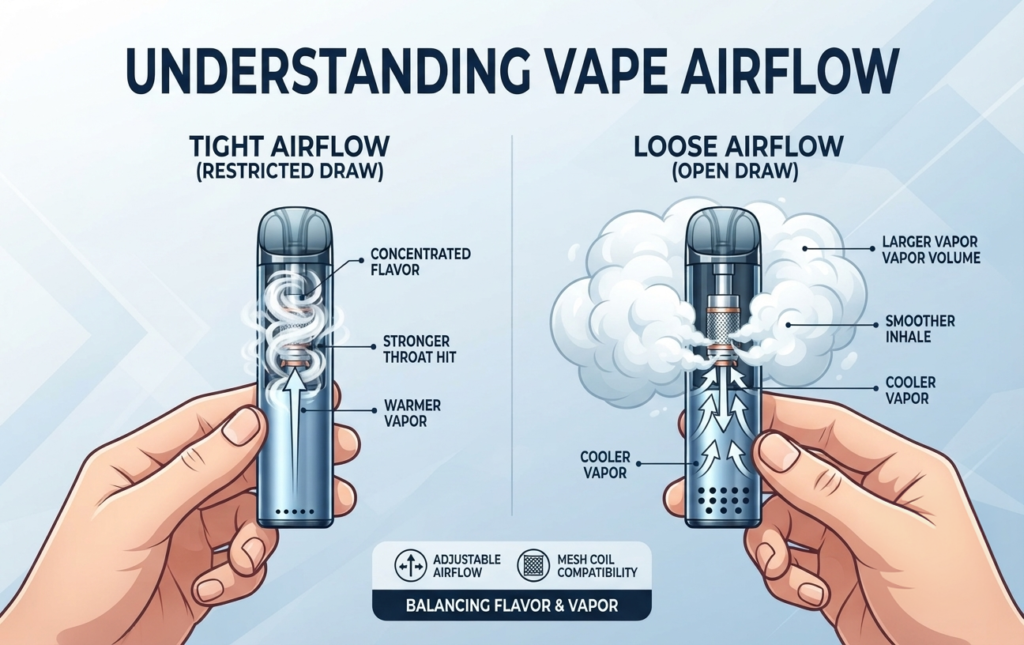
1. Tight Airflow (Restricted Draw)
A tight airflow design provides a more restricted inhalation experience.
Characteristics include:
- Less air entering the device
- More concentrated vapour
- Stronger flavour perception
- A sensation closer to traditional smoking styles
This type of airflow is often preferred by users who enjoy:
- A slower, controlled draw
- Strong flavour intensity
- A more traditional mouth-to-lung experience
However, because less air passes through the heating system, the device must carefully manage heat to maintain consistency.
2. Loose Airflow (Open Draw)
Loose airflow allows more air to enter during inhalation.
Characteristics include:
- Larger vapour volume
- Cooler vapour
- Smoother inhalation
- More open breathing sensation
Many users prefer open airflow because it creates a lighter and smoother experience.
Advantages include:
✓ Larger vapour production
✓ Reduced heat sensation
✓ Comfortable longer draws
The challenge for manufacturers is maintaining strong flavour while allowing more airflow.
3. Adjustable Airflow Systems
Some advanced vape devices include adjustable airflow options.
This allows users to customize their experience by changing the amount of air entering the device.
Users can choose:
- A tighter draw for stronger flavour
- A more open draw for smoother vapour
Adjustable airflow provides flexibility for different preferences.
How Airflow Affects Flavour
Airflow plays a major role in flavour delivery.
A balanced airflow system helps ensure that:
- E-liquid vapour reaches the user consistently
- Flavour compounds are delivered evenly
- The heating system operates efficiently
If airflow is too restricted, the vapour may become warmer and the flavour may feel heavier.
If airflow is too open, the flavour may feel lighter because the vapour is mixed with a larger volume of air.
The ideal airflow depends on the flavour profile and the user’s preference.
How Airflow Affects Vapour Production
Vapour production depends on several factors:
- Coil technology
- Battery output
- E-liquid formulation
- Airflow design
Airflow influences how much vapour can be comfortably inhaled.
A well-balanced system allows sufficient air circulation around the heating element, helping create smooth and consistent vapour.
This is especially important for high-capacity disposable vapes, where maintaining performance throughout thousands of puffs requires efficient airflow management.
Mesh Coil Technology and Airflow Design
Modern disposable vapes increasingly use mesh coil technology.
Unlike traditional wire coils, mesh coils use a larger heating surface area, which can provide:
- More even heating
- Faster response time
- More consistent flavour delivery
However, mesh coil performance depends heavily on airflow design.
A well-designed airflow system helps:
- Maintain suitable coil temperature
- Deliver balanced vapour density
- Improve flavour consistency
This combination of mesh coil technology and optimized airflow has become a major trend in newer-generation disposable vapes.
Common Airflow Problems and Solutions
Problem 1: Weak Flavour
Possible causes:
- Too much airflow
- Blocked airflow pathways
- Device nearing the end of its lifespan
Solutions:
✓ Check airflow openings
✓ Avoid covering airflow holes
✓ Store the device properly
Problem 2: Harsh or Hot Vapour
Possible causes:
- Restricted airflow
- Taking repeated long draws
- Insufficient cooling airflow
Solutions:
✓ Allow time between puffs
✓ Use moderate inhalation strength
✓ Check for airflow blockage
Problem 3: Inconsistent Vapour Production
Possible causes:
- Poor airflow balance
- Battery performance changes
- E-liquid supply limitations
Solutions:
✓ Choose quality devices
✓ Maintain proper storage conditions
✓ Avoid extreme temperatures
How ALIBARBAR Uses Airflow Design to Improve Experience
Modern disposable vape engineering focuses on creating a balance between flavour, vapour production, and comfort.
The ALIBARBAR INGOT series incorporates design elements including:
- Optimized airflow channels
- Advanced heating systems
- High-capacity battery technology
- Consistent vapour delivery design
The goal is to provide a smoother and more reliable experience throughout the device lifespan.
Airflow is not just about producing more vapour—it is about creating the right balance between flavour intensity, smoothness, and user comfort.
How to Choose the Right Airflow Experience
Different users prefer different vaping styles.
Consider your preference:
If you prefer stronger flavour:
Look for:
- More concentrated airflow
- Balanced vapour density
- Rich flavour delivery
If you prefer smoother vapour:
Look for:
- More open airflow
- Cooler vapour production
- Comfortable longer draws
If you are new to disposable vapes:
A balanced airflow design is usually the easiest option because it provides a combination of:
- Smoothness
- Flavour clarity
- Comfortable vapour production
Final Thoughts
Airflow is one of the key technologies that shapes the modern vaping experience.
Although it is often hidden inside the device, airflow design influences almost every aspect of vaping—from flavour intensity and vapour production to smoothness and comfort.
A well-engineered airflow system creates harmony between the heating element, e-liquid, and user’s inhalation style.
When choosing a disposable vape, understanding airflow can help you select a device that better matches your personal preference.
Better airflow design means a more consistent experience, better flavour balance, and more enjoyable vaping.
References & Data Sources
- National Academies of Sciences, Engineering, and Medicine – Public Health Consequences of E-Cigarettes (Device Characteristics and Aerosol Formation)
https://nap.nationalacademies.org/catalog/24952/public-health-consequences-of-e-cigarettes - U.S. Food and Drug Administration (FDA) – Vapour Products and Electronic Nicotine Delivery Systems Information
https://www.fda.gov/tobacco-products/products-ingredients-components/e-cigarettes-vapes-and-other-electronic-nicotine-delivery-systems-ends - American Journal of Preventive Medicine – Research on Electronic Cigarette Device Characteristics and User Experience
https://www.ajpmonline.org/ - Battery University – Lithium-Ion Battery Performance and Temperature Effects
https://batteryuniversity.com/article/bu-702-how-to-store-batteries - Journal of Aerosol Science – Studies on Aerosol Generation and Flow Characteristics in Electronic Devices
https://www.sciencedirect.com/journal/journal-of-aerosol-science